Articles · Kosher
Date-planning guide
The wine rule nobody explains, and five more kosher date-night landmines
If one of you keeps kosher and the other doesn't, most of the friction comes from terms that sound self-explanatory and aren't. Here is what six of them actually mean, according to the certifying agencies themselves — and what each one changes about where you can eat together.
By the Date Your Diet teamUpdated August 20268 min read
Lifestyle information, not medical advice or religious guidance — for questions of personal observance, ask your own rabbi. This page describes what certifying agencies publish about their own standards; it does not tell anyone what to observe.

Why these six, and not a list of rules
Nothing below is a ruling. Each item is something a named certifying agency — the Orthodox Union (OU), Star-K, or the Chicago Rabbinical Council (CRC) — has published about its own standards, followed by the practical thing it changes when two people are choosing a restaurant. Where observant practice varies, this page says so rather than picking a side.
1. The wine rule: who is allowed to pour
Wine and grape juice carry a distinct rule that has nothing to do with ingredients. CRC states it directly: “if the wine is touched or moved by someone who is not Jewish, it becomes forbidden. For this reason, wine (and wine vinegar) without hashgachah is not kosher, since the assumption is that it is stam yayin.”
The exception is mevushal wine — literally “cooked.” Per CRC: “One important exception to this halacha is that once the wine is mevushal, it cannot become forbidden. […] wine which is mevushal has a significant advantage, in that it will not become forbidden if touched or moved by someone non-Jewish, such as a waiter or a cleaning person.” CRC notes that most American hashgachos (certifying bodies) accept modern pasteurization as satisfying mevushal.
What it changes at dinner. A bottle of non-mevushal wine that a non-Jewish server opens or pours becomes non-kosher by this rule, regardless of the label's certification before that point. A mevushal bottle carries no such restriction and a server can pour it freely. So the checkable detail on the label isn't “kosher wine” — it's whether the bottle specifies mevushal, because that is what determines who may pour.
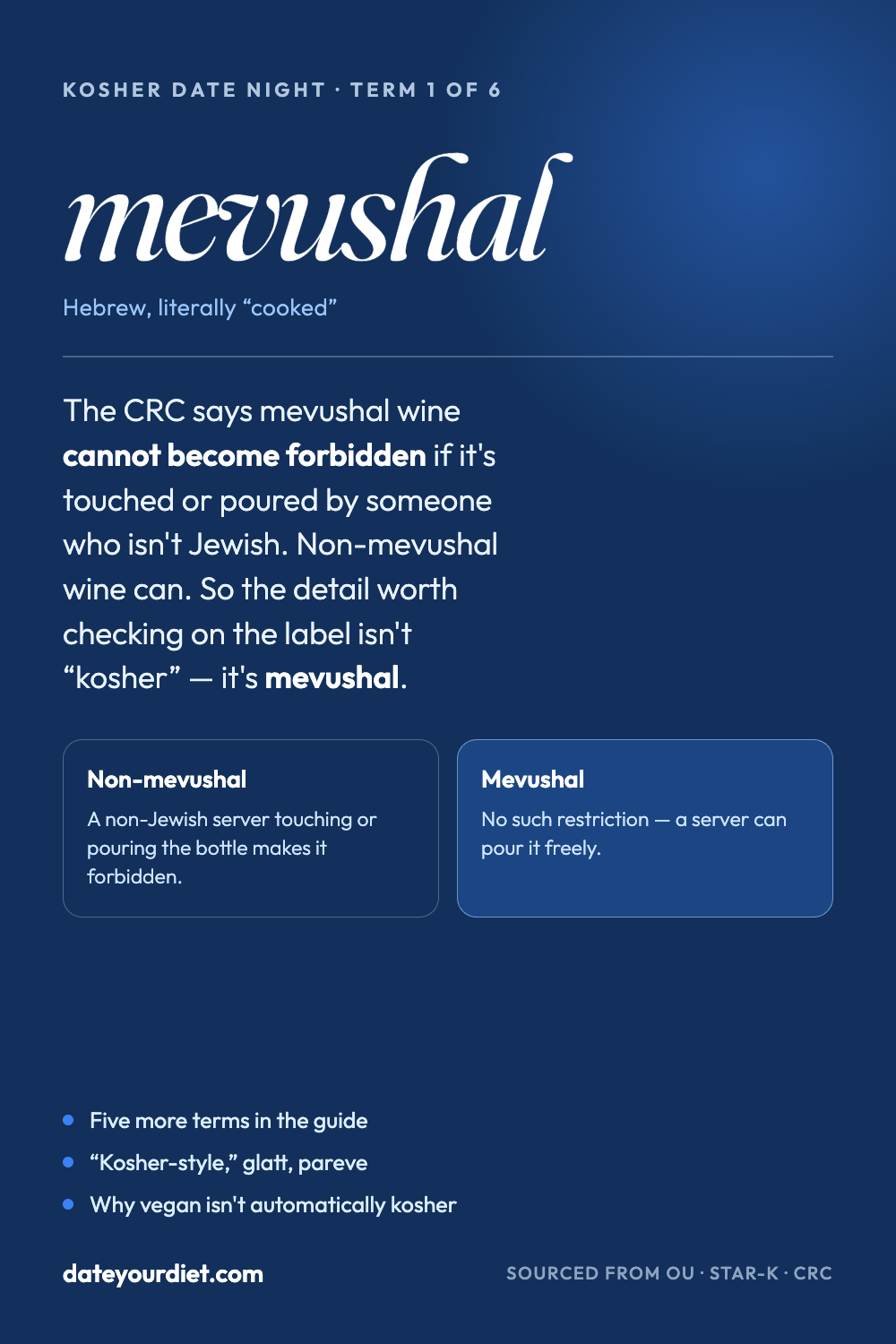
mevushal — Hebrew, literally “cooked”
The whole rule in one graphic: which bottle a server can pour, and the word to look for on the label. Sourced from OU, Star-K, and CRC.
Open full size →2. “Kosher-style” is not a certification claim
YeahThatsKosher defines it plainly: “Kosher-style food refers to cuisine that mimics traditional Jewish foods but may not be prepared according to Jewish dietary laws.” The examples it gives are exactly the ones that mislead — “matzo ball soup made with non-kosher chicken, bagels with lox in a deli that also serves pork, or pastrami sandwiches stacked high on rye, right next to a menu offering cheeseburgers.” Its bottom line: “If a place or product lacks a legitimate kosher certification from a rabbinical authority, it cannot be considered kosher, no matter how traditional or Jewish it seems.”
What it changes at dinner. A restaurant describing itself as kosher-style is making zero certification claim: supervision, sourcing, and meat and dairy separation are all unconfirmed. It's a description of the cuisine, not of compliance, so a “kosher-style deli” is not a safe default to fall back on when you're short on options.
3. A vegan restaurant is not automatically a solution
This is the assumption most likely to send a mixed couple to the wrong restaurant. CRC answers the exact question — whether it's all right to eat at a non-kosher vegan restaurant, since there's no meat, fish, or cheese — with: “by no means will that result in the food actually being kosher. This is because there are at least 3 ways that vegan food can be non-kosher.”
- Insect checking. Per CRC, most salad greens “require checking and washing to ensure they are free of insects. […] we know that small insects will remain, unless someone follows more rigorous procedures, such as those provided by hashgachos.”
- Wine and grape juice. The rule from the first section applies here too — non-mevushal wine or grape juice touched or moved by someone who is not Shomer Shabbos is forbidden as stam yayin, and would be used at a vegan restaurant.
- Bishul akum — which Star-K's glossary defines concisely as “food cooked by a Gentile.” CRC applies it to the vegan case: any food not edible raw and fit to serve to distinguished guests “is only kosher if a Jewish person participated in the cooking,” which covers “many of the starches that might be served at vegan restaurants, such as rice, potatoes, pasta, and quinoa.”
CRC adds that a vegetarian restaurant raises a further concern, gevinas akum — “the Rabbinic requirement that a Jew participate in the creation of hard cheese” — and that even a dish clear of all the above can be compromised by shared equipment (keilim): “if my food was prepared with the same pots and knives as non-kosher food, the non-kosher ta'am (taste) absorbed into those dishes can potentially spread into my food.” CRC's stated conclusion is that “non-certified restaurants are not recommended for kosher consumers, even if those restaurants have menus that seem somewhat kosher-friendly.”
Practice varies, and this page isn't adjudicating it. That is CRC's position, stated as a recommendation rather than a description of how everyone behaves. The OU treats the adjacent question — a plain salad at a non-kosher restaurant — as a live one: its post on the subject has the OU's Rabbinic Administrator, Rabbi Moshe Elefant, examine it directly. That such an explainer exists is itself a sign this is worked through individually rather than settled uniformly. Practice on minimally processed items at non-certified restaurants differs among observant people, and it is a question for your own rabbi, not for an article.
What it changes at dinner. “It's vegan, so it should work for both of us” solves the meat-and-dairy problem and introduces at least three others — insects, wine, and bishul akum — none of which have anything to do with the ingredients being plant-based. If the vegan restaurant is the compromise, it's worth knowing that's what you're choosing.
4. What “glatt” actually denotes
Star-K's glossary: glatt “refers to beef from kosher-slaughtered animals whose lungs are free of adhesions.” OU's glossary describes the same mechanism — “An animal whose lungs contained no questionable adhesions that could pose potential kosher problems is considered glatt” — literally “smooth.”
Both agencies define it as a specific anatomical standard applied to meat at slaughter. It is not a general synonym for stricter kosher, and it does not apply to non-meat food at all.
What it changes at dinner. “Glatt kosher” on a steakhouse's signage is a claim about how that establishment's beef was inspected — not a broader assurance about the wine, the dairy, or the produce, which are governed by the separate rules above.
5. Pareve answers one question, not three
Star-K defines pareve as “a product that contains no derivatives of poultry, meat or dairy ingredients and can be eaten with a meat, poultry or dairy meal.” The OU adds the equipment condition explicitly: pareve means “neither meat nor dairy (and can therefore be eaten with either), and was not manufactured on meat or dairy equipment.” That equipment clause is load-bearing, not incidental — it is the same shared-equipment problem CRC describes under keilim.
What it changes at dinner. Pareve certifies one thing: whether a food can go with either a meat or a dairy meal. It is not an allergen claim, and it isn't established by an ingredient list alone — the equipment history is part of what supervision confirms.
6. “Certified” means nothing until it names the certifier
There is no single US government kosher standard. The OU says so in the context of comparing kosher labeling to other voluntary claims: “‘Dairy-free’, ‘non-dairy’, ‘plant-based’, ‘kosher’, and ‘Vegan’ labeling are all voluntary label claims, and while the FDA has no meaningful regulation for these meaningful marketing claims, OU kosher and BeVeg Vegan certification standards exist to clear consumer confusion.” The same piece notes that consumer protection law is supposed to shield buyers from misleading label claims, “but that is not the case while these labels remain largely unregulated.”
Certification is private and agency-specific rather than one universal seal. Star-K's own explainer states that “All kosher certification agencies are not identical,” and stresses that “it is essential that the kosher certification agency has widespread acceptability so that a product bearing its symbol can be marketed to as wide an audience as possible.” The OU demonstrates the same point within a single agency: plain OU is pareve, OU-D is dairy, OU-M is meat, OU-F is fish, and OU-P is kosher for Passover. One body already needs several distinct marks, which is a good sign that “certified kosher” is not one undifferentiated claim.
What it changes at dinner. A restaurant calling itself “certified kosher” without naming the agency — OU, Star-K, CRC, Kof-K, OK, or another — isn't giving verifiable information; there is no government registry behind the word the way there is for USDA Organic. The practical move is the one you'd use for any unfamiliar restaurant claim: look for the named agency's actual symbol on the door or the menu, rather than the word “kosher” on its own. This article names those agencies as real certifying bodies; it doesn't rank them or vouch for one over another.
The version of this that fits on a text message
If one of you keeps kosher and the other is picking the restaurant for the first time, three questions cover most of it: which agency certifies this place, is the wine mevushal, and — if the answer to the first is “none” — does the person who keeps kosher want to eat there at all. The last question is theirs to answer, and asking it in advance is a great deal better than discovering it at the table.
Would you go?
Say you would go on this date, and find people who would go with you.
Be the first to say you'd go on this date
Meet in public and tell a friend where you’re going.
Not medical advice — lifestyle information only.
Sources
Every claim above is quoted from a named certifying agency's own published page. Where those agencies differ, or where individual practice varies, that is stated in the text rather than resolved here.
- CRC Consumer Kosher — Wine (Rabbi Dovid Cohen, March 2024)
- CRC Consumer Kosher — Vegan Restaurant (Rabbi Dovid Cohen, July 2024)
- YeahThatsKosher — Is Kosher-Style, Kosher? The Answer is in the Name
- Star-K — Glossary
- Star-K — What is a Kosher Certification Agency?
- OU Kosher — Kosher Certification Terms
- OU Kosher — All OU Symbols Explained
- OU Kosher — What Kosher, Vegan and Plant-Based Label Claims Really Mean
- OU Kosher — Salad in a Non-Kosher Restaurant
Read next
Say it once, on your profile.
Set your food life up front — what you keep, what you'd rather not explain again, and the restaurants you'd both say yes to — and see who already fits it.
Create your free profileFree to create a profile, take the compatibility quiz, and chat with mutual matches.