Articles · Mixed diets
Reference guide
Which cuisines actually feed a mixed-diet couple
One of you is keto, the other is vegan, and someone at the table can't have gluten. This is a cuisine-by-cuisine look at which kitchens can genuinely serve all of you at once — and which ones quietly make one person the compromise.
By the Date Your Diet teamUpdated August 20269 min read
Lifestyle information, not medical advice. If a food restriction is medical — celiac disease, a diagnosed allergy, or anything your doctor set — follow their guidance over anything on this page.
Why the cuisine decides more than the restaurant
When two people eat by different rules, the question isn't really which restaurant to pick — it's whether that kitchen's whole way of cooking has room for both of you. Three definitions do most of the work here.
Vegan is defined by The Vegan Society, which coined the term in 1944, as “a philosophy and way of living which seeks to exclude — as far as is possible and practicable — all forms of exploitation of, and cruelty to, animals for food, clothing or any other purpose.” At a restaurant table that means no meat, poultry, fish or shellfish, dairy, eggs, or honey.
Keto, for ordering purposes, is a very-low-carbohydrate, high-fat way of eating. The foods to actively avoid across every cuisine are grains and anything made from them — bread, pasta, rice, noodles, tortillas, batter and breading — plus starchy vegetables, legumes, sugary sauces and dressings, and most fruit.
Gluten-free is the one where ingredient choice isn't the whole story. Cross-contact is a distinct risk: even a naturally gluten-free dish, like rice or a plain grilled protein, can pick up gluten from a shared cutting board, fryer oil, griddle, or utensil that also touches wheat-based food. Shared cooking spaces, shared griddles and spatulas, and staff not changing gloves between orders are the things to watch for.
Four ingredients that decide most of the table
Before any specific cuisine, a handful of default ingredients explain most of the surprises in this table.
- Soy sauce is not gluten-free. Traditional soy sauce is brewed with wheat as a primary ingredient. Tamari, a Japanese style made without wheat, and coconut aminos are the standard substitutes — but only if the restaurant is actually using one of them. This single fact governs a large share of the gluten-free pitfalls in Japanese, Chinese, and Thai cooking.
- Fish sauce and oyster sauce are common hidden non-vegan ingredients. Both are used by default across Southeast and East Asian cooking and are easy to miss, because the dish itself — a vegetable stir-fry, a curry — looks plant-based. Worcestershire sauce is traditionally made with anchovies for the same reason.
- Ghee is dairy. Clarified butter is a default cooking fat in a large share of Indian restaurant dishes, including vegetarian ones, so “vegetarian” on an Indian menu is not the same claim as “vegan.”
- Corn tortillas are naturally gluten-free; flour tortillas are wheat. The caveat is that some producers make both on shared equipment, so cross-contact is possible unless the tortilla is specifically labeled gluten-free.
Cuisine by cuisine
Read a row across: what that kitchen can do for each person, then whether the table works for all of you at once.
| Cuisine | Keto | Vegan | Gluten-free | If you're a mixed table |
|---|---|---|---|---|
| Italian | Works with a request. Grilled or roasted meat, poultry, and fish, plus salads without croutons. The identity dishes — pasta, risotto, bread, pizza — are all grain-based. | Works with a request. Tomato-based sauces, roasted vegetables, and bean or vegetable soups. Confirm a sauce is dairy-free rather than assuming; cheese and butter are the flavor bases. | Works with a request. Risotto is rice-based but carries cross-contact risk from wheat-based stock and shared pasta-station tools. If ordering gluten-free pasta, ask whether it's cooked in dedicated water. | Best here for vegan plus gluten-free: plant-forward tomato and vegetable dishes alongside a risotto or gluten-free pasta cover both. Hardest for keto plus vegan — the vegan diner's easiest options are pasta, beans, and bread, exactly what keto skips, leaving them mostly a side salad. |
| Mexican | Works well. A protein ordered as a bowl or fajita plate with lettuce, salsa, guacamole, sour cream, and cheese, skipping rice, beans, and tortillas. | Works with a request. Bean and vegetable fajitas, guacamole, salsa, and corn tortillas. Ask whether the refried beans are made with lard — traditionally they are. | Works well. Corn tortillas are the safe default; flour tortillas are wheat. Watch shared surfaces between the two and confirm sauces aren't thickened with flour. | One of the strongest cuisines for a mixed table. The fajita or bowl format lets each diner build a plate from one shared set of components, so all three constraints are usually satisfied from a single menu section without special-ordering a separate dish. |
| Japanese / sushi | Works well. Sashimi is close to zero net carbs and one of the most naturally keto-friendly restaurant orders anywhere. Sushi rice is sweetened; skip teriyaki, which is functionally a sugar syrup. | Works with a request. Cucumber and avocado rolls and edamame are reliable. Miso soup usually is not — the stock is traditionally built on bonito (dried fish) flakes. | Works with a request. Ask for tamari instead of soy sauce. Imitation crab is typically bound with wheat-containing starch, and tempura is wheat-battered. | The hardest of the ten to satisfy all three at once: keto's safe zone (sashimi, no rice) and vegan's (cucumber and avocado rolls, which need rice to hold together) barely overlap. Edamame comes closest to working for everyone, but it's a side, not an entree. |
| Thai | Works with a request. Curries built on unsweetened coconut milk with a protein and non-starchy vegetables — green or red rather than yellow, which typically includes potatoes. Ask for no added sugar explicitly. | Works with a request. Curries and stir-fries can be made with tofu and vegetable broth, but fish sauce is a default seasoning across most savory dishes and needs an active substitution request. | Works with a request. Rice and rice noodles are naturally gluten-free. The hazards are oyster sauce and regular soy sauce — ask for tamari and confirm the noodles are rice, not wheat. | Serves keto plus gluten-free well: the two hazards, sugar and wheat-based sauces, are separable and both are things a kitchen can leave out. Vegan is the constraint diner, because fish sauce is the default rather than an optional add. |
| Indian | Works with a request. Tandoori and tikka preparations are naturally low-carb before sauce. Creamy curries often have added sugar or a flour thickener; skip rice and naan. | Works well. One of the deepest plant-based traditions on this list — dal, chana masala, aloo gobi, and vegetable curries are core menu items. Flag ghee (clarified butter) and paneer, which make a dish vegetarian but not vegan. | Works with a request. Naan, roti, chapati, paratha, kulcha, and puri are wheat. Rice is a safe base, and pakora batter is usually chickpea flour — though shared fryer oil is a cross-contact risk. Ask whether curries are thickened with wheat flour. | The strongest cuisine here for vegan plus gluten-free — rice-based lentil and vegetable curries are naturally both, across a large share of the actual menu rather than as a workaround. Vegan plus keto is harder: the naturally vegan dishes lean on legumes and rice. |
| American steakhouse | Works well. The strongest cuisine on this list for keto — a protein plus a non-starchy vegetable side is the default order, not a workaround. Watch marinades and sauces for hidden sugar and wheat. | Hard here. The weakest cuisine on this list for vegan. Plant-based entrees are typically not on the menu at all, leaving salad and vegetable sides. This is a structural gap, not a minor pitfall. | Works well. Plain protein and vegetables cooked in a clean pan. The hazards are the bread basket, croutons, breaded appetizers, and wheat-brewed soy sauce in marinades. | Keto plus gluten-free land on the exact same order: plain protein, vegetable side, sauce on the side or skipped. This is the one cuisine on the list where the honest answer for a couple including a vegan is to pick a different restaurant, not to make it work. |
| Mediterranean / Greek | Works with a request. Grilled meat, poultry, and fish and salads dressed in olive oil. Hummus and falafel are plant-based but chickpeas are a higher-carb food group for keto purposes. | Works well. Hummus, baba ganoush, falafel, and vegetable dishes are naturally vegan staples. Tzatziki and feta are dairy defaults on many platters and need to be left off. | Works well. Most Greek food outside breads and pastries is naturally gluten-free. Pita, orzo (a wheat pasta shaped like rice), and the bulgur in tabbouleh are not. | The chickpea dishes are the natural overlap for vegan plus gluten-free — both naturally, not as a substitution. Keto plus vegan is a moderate compromise: olives, tahini-based dips, and non-starchy vegetables exist, but the two headline vegan dishes are legume-based. |
| Chinese | Works with a request. Steamed or stir-fried protein with non-starchy vegetables, sauce on the side. Hoisin is high in sugar and cornstarch, and orange chicken sauce is built on sugar over a cornstarch-coated fried protein. | Works with a request. Tofu dishes and vegetable stir-fries. A dish named “in oyster sauce” is not vegan by default, and fried rice commonly contains egg unless ordered without. | Hard here. The most concentrated gluten hazard on the list: lo mein, chow mein, and most soup noodles are wheat, wrappers generally are too, and soy, oyster, and hoisin sauces are typically wheat-containing. Shared woks add cross-contact risk. | Where the three diets' hazards collide hardest in one place — the defining sauces threaten gluten-free (wheat), keto (sugar), and, in oyster sauce's case, vegan (shellfish) at once. A mixed table depends on the kitchen customizing the sauce: steamed or dry stir-fried protein and vegetables with sauce on the side is the one adaptable order. |
| Breakfast / brunch diner | Works well. Eggs, bacon, sausage, and avocado are standard menu items and keto-compatible as they come. Toast, hash browns, pancakes, waffles, and juice are the ones to skip. | Hard here. Structurally weak: the classic diner menu is built around animal products as defaults, and plant-based substitutes exist only if that diner has added them. Fruit, oatmeal, and dry toast are the fallback. | Works with a request. Eggs, bacon, sausage, and hash browns can be gluten-free if they aren't cooked on a griddle shared with pancake and waffle batter. Some kitchens manage that well; others don't. | Keto plus gluten-free is the strong pairing — both land on eggs and a protein cooked on a clean pan rather than the shared griddle, which is the same request either diner needs to make. Vegan is again the constraint diner unless the specific diner states a plant-based option. |
| Pizza | Hard here. The weakest cuisine on this list for keto by a wide margin. The only workable orders are a cauliflower crust or a crustless pizza bowl, where the venue offers one. | Works well. Straightforward: vegetable toppings on a marinara base with the cheese omitted, or a vegan cheese substitute where the pizzeria carries one. | Works with a request. Many pizzerias stock a gluten-free crust, so the real question is oven procedure — dedicated pans or peels and separate toppings containers — rather than ingredient availability. | Works as a mixed-diet venue for vegan plus gluten-free at a pizzeria stocking both a gluten-free crust and vegan cheese; both are common enough to ask for. If keto is at the table, this is the cuisine to skip rather than try to make work, unless the venue does a genuine cauliflower crust or crustless option. |
Swipe the table sideways to see every column.
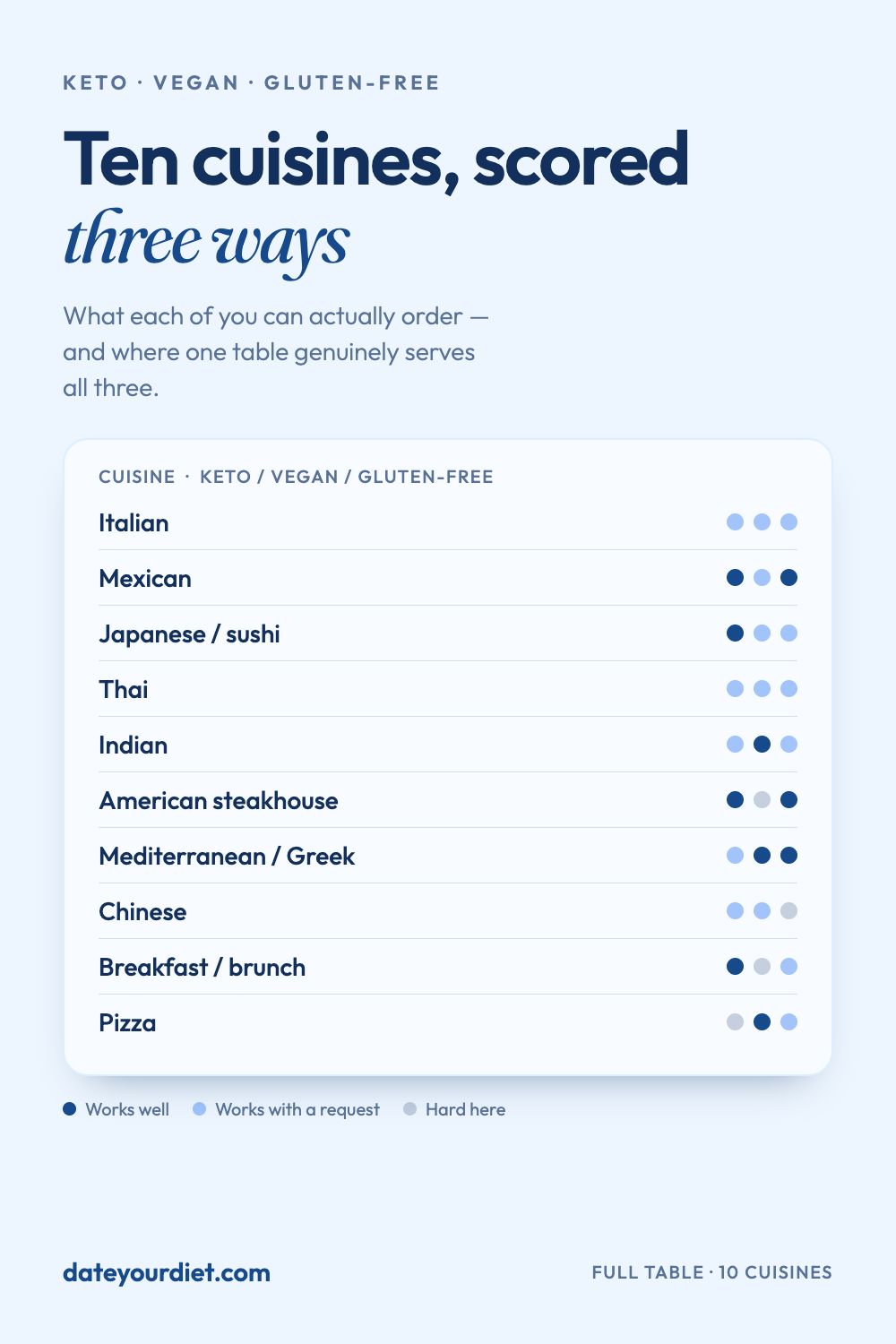
Ten cuisines, scored three ways
The same ten verdicts as the table above, condensed into one card you can keep on your phone for the next time you're picking a restaurant together.
Open full size →Where a mixed table works, and where it doesn't
Read down the verdict column and a pattern shows up that has nothing to do with how good the food is. What separates an easy cuisine from a hard one is whether the kitchen builds a plate from parts or from a finished dish.
Mexican and Indian are the two easiest tables
Mexican works because of format. A fajita or bowl gives every diner the same shared set of components — protein, guacamole, salsa, cheese, lettuce, corn tortillas, rice, beans — so keto skips the starches, a vegan skips the meat and confirms the beans are lard-free, and a gluten-free diner sticks to corn. Nobody has to special-order a separate dish.
Indian works because of depth. Dal, chana masala, aloo gobi, and mixed vegetable curries are core menu items rather than accommodations, and served over rice they are naturally vegan and naturally gluten-free at the same time. The two things to name at the table are ghee and paneer.
Sushi and Chinese are the hardest — and the fix is the same
At a sushi restaurant, the trouble is that the safe zones don't overlap: a vegan roll needs rice to hold together, and rice is the thing keto is avoiding. At a Chinese restaurant, the trouble is concentrated in the sauces, which manage to threaten all three diets at once — wheat for gluten-free, sugar for keto, shellfish for vegan.
In both kitchens the one order that adapts is the same: steamed or dry stir-fried protein and vegetables, sauce on the side. It isn't on the menu that way, and it's worth asking for by phone before you book rather than negotiating at the table.
Two cuisines where the honest answer is to eat somewhere else
A steakhouse is the best restaurant on this list for keto and among the easiest for gluten-free — and the worst for a vegan, who typically has no entree on the menu at all. Pizza is the mirror image: easy for vegan, easy enough for gluten-free at a pizzeria with good oven procedure, and effectively unservable for keto unless the venue does a genuine cauliflower crust or crustless option.
Those two are worth saying out loud, because the failure mode of a mixed-diet date night isn't a bad meal — it's one person spending the evening eating sides and pretending that's fine. Picking a different cuisine is a smaller concession than picking a different partner.
Would you go?
Say you would go on this date, and find people who would go with you.
Be the first to say you'd go on this date
Meet in public and tell a friend where you’re going.
Not medical advice — lifestyle information only.
Sources
Every fact, verdict, and dish example above traces to one of these. Nothing here is an ingredient list for a specific restaurant — menus and procedures vary by venue, so the questions in this guide are meant to be asked, not assumed.
- The Vegan Society — Definition of Veganism
- Diet Doctor — Keto diet foods
- Diet Doctor — Low Carb Around the World
- Beyond Celiac — Cross-Contact
- Beyond Celiac — Is Soy Gluten-Free?
- Beyond Celiac — Is Risotto Gluten-Free?
- Beyond Celiac — Is Sushi Gluten-Free?
- Beyond Celiac — Is Pad Thai Gluten-Free?
- NIMA — Is Soy Sauce Gluten Free? A Brand-by-Brand Breakdown
- Healthier Steps — Is Soy Gluten Free?
- WebMD — Differences Between Corn vs. Flour Tortillas
- Celiac.com — Gluten-Free Naan / Roti: Indian Flat Bread
- Celiac.com — The Greek Cuisine
- Celiac.com — The Safest Thing to Order at a Restaurant Without a Gluten-Free Menu
- Celiac.com — Top Brands of Gluten-Free Steak Sauce
- Celiac.com — Gluten-Free Chinese & Asian Recipes
- FindMeGlutenFree — IHOP
- ScienceDirect — Risk of Cross-Contact for Gluten-Free Pizzas in Shared-Production Restaurants in Relation to Oven Cooking Procedures
- Healthline — Keto Mexican Food: Dishes, Ordering Tips, and Recipes
- Healthline — 15 Keto-Friendly Chinese Foods
- Healthline — Is Miso Soup Vegan?
- Tasting Table — The Sneaky Reason Most Refried Beans Are Not Vegetarian
- Ruled Me — Can You Eat Sushi on Keto?
- Ruled Me — The Keto Indian Food Guide
- BetterMe — Keto-Friendly Thai Food
- KetoVale — Top 15 Low Carb Options at Thai Restaurants
- Malaysian Vegan — Hidden Ingredients guide
- IngrediCheck — Fish Allergy Dietary Guide
Read next
Stop negotiating dinner on the third date.
Set your food life once — diet, allergies, cooking habits, the restaurants you'd say yes to — and see who already fits it.
Create your free profileFree to create a profile, take the compatibility quiz, and chat with mutual matches.