Articles · Renal
Date-planning guide
There is no renal diet — there is their plan
A renal eating plan is written for one person's labs, and it changes. Here is what that actually means when the two of you are picking a restaurant — and how to be helpful without policing anyone's plate.
By the Date Your Diet teamUpdated August 20268 min read
Lifestyle and etiquette information, not medical advice. Renal nutrition is individually prescribed — a person's plan is set by their own doctor or renal dietitian based on their kidney function, their treatment, and their lab results, and it changes over time. Nothing here tells anyone what to eat, and nothing here is a substitute for that person's own care team. This page is written for the date or partner, not the patient.

1. Why there is nothing here for you to look up
The single most useful thing to understand before dinner is that there is no standard kidney diet you could look up and apply. NIDDK, part of the National Institutes of Health, states it plainly: “There is no single meal plan for everyone with CKD. In the early stages of CKD, you may have few limits to what you can eat and drink. As your CKD advances and your nutritional needs change, you may need to make more changes to your diet.”
The plan is also written by a professional for that specific person. NIDDK: “Your health care professional may recommend you choose foods more carefully and may suggest you work with a registered dietitian, if possible, to create an eating plan for your individual needs.” The National Kidney Foundation says the same thing about dining out specifically: “Every patient has different nutritional needs, so speak with your dialysis dietitian.”
So two people with kidney disease sitting at neighboring tables can be working from genuinely different instructions — different stage, different treatment, different labs, different month. Whatever you read on the internet about kidney diets, including this page, is not their plan.
What it changes at dinner. You are not the person who knows. Neither is Google, and neither is the server. Your only reliable source about their limits is them — which is why every practical suggestion further down is a question you ask rather than a rule you apply.
2. What the plan is usually built around, and why
You don't need to know their numbers, but a general sense of which things get managed makes you a better restaurant partner, because it explains why the choice of place matters more than the choice of dish.
NIDDK describes what each one does in the body:
- Sodium. “Sodium is a mineral that helps control the amount of fluids in your body. Sodium is found in table salt and in many processed foods. Too much sodium causes your blood to retain—or hold on to—fluids. When your body retains fluids, it can cause high blood pressure and swelling, putting stress on your kidneys and heart.”
- Potassium. “CKD can make it harder for the kidneys to remove potassium from the blood, and the potassium levels in the blood can become very high. Having too little or too much potassium in your blood can cause heart and muscle problems. For this reason, it's important to work with a dietitian or health care professional to help find the right amount of potassium for you.”
- Phosphorus. High levels “can harm your blood vessels and make your bones thin, weak, and more likely to break,” and “can also cause itchy skin and bone and joint pain.”
- Protein. “As your body uses protein, the protein breaks down into waste. Your kidneys remove this waste from the blood.” NIDDK notes both directions matter: some people may need moderate amounts “so waste doesn't build up in the blood. However, too little protein may lead to malnutrition.”
Note what that last one means: this is not a list of things to minimize. Protein needs can go up — the National Kidney Foundation's own dining-out guidance for people on dialysis says that on dialysis “both animal proteins (beef, pork, poultry, fish, and eggs) and plant-based proteins are helpful to maintain muscle mass.”
What it changes at dinner. Drop the assumption that a kidney diet is a restriction diet where less of everything is safer. It is a balance, tuned per person and in more than one direction, which is exactly why guessing on their behalf doesn't work even when you're trying to be careful.
3. The phosphorus that isn't on the label
This is the fact most worth carrying around, because it is invisible and it is concentrated in restaurant food.
Phosphorus occurs naturally in food, but it is also added during processing, and the added kind behaves differently in the body. The National Kidney Foundation: “Phosphorus that has been added to food in the form of an additive or preservative (inorganic phosphorus) is found in foods such as fast foods, ready to eat foods, canned and bottled drinks, enhanced meats, and most processed foods. Phosphorus from food additives is completely absorbed.”
Elsewhere NKF gives the contrast directly: “Your body absorbs 70% of the phosphorus in dried beans, legumes, and nuts, but it absorbs 100% of the phosphorus in processed foods.” And on fast food, its guidance is blunt: “Slow down and check fast foods. Many have high phosphorous.”
The part that makes this a restaurant problem rather than a grocery problem is the labeling. NKF: “The U.S. Food and Drug Administration does not require reporting of phosphorus on food labels, so how much phosphorus there is in a food can be hard to figure out.” On a packaged product there is at least a workaround — NKF advises that “Phosphorus additives are found on the list of ingredients on the nutrition facts label. Look for ‘PHOS’ to find phosphorus additives in the food,” naming examples such as disodium phosphate, phosphoric acid, and sodium tripolyphosphate. A restaurant menu offers no ingredient list at all.
Worth noticing too is one category NKF puts on that list alongside fast food and canned drinks: “enhanced meats.” A grilled chicken breast can read as the plainest thing on the menu and still sit inside the group NKF names.
What it changes at dinner. A restaurant where food is cooked from raw ingredients gives your date more information to work with than one assembling pre-made components, and neither the menu nor the server is likely to know the difference on request. If you're the one choosing, “fresh-cooked kitchen” is a more useful filter than “healthy-looking menu” — and it's a filter you can apply without ever raising the subject.
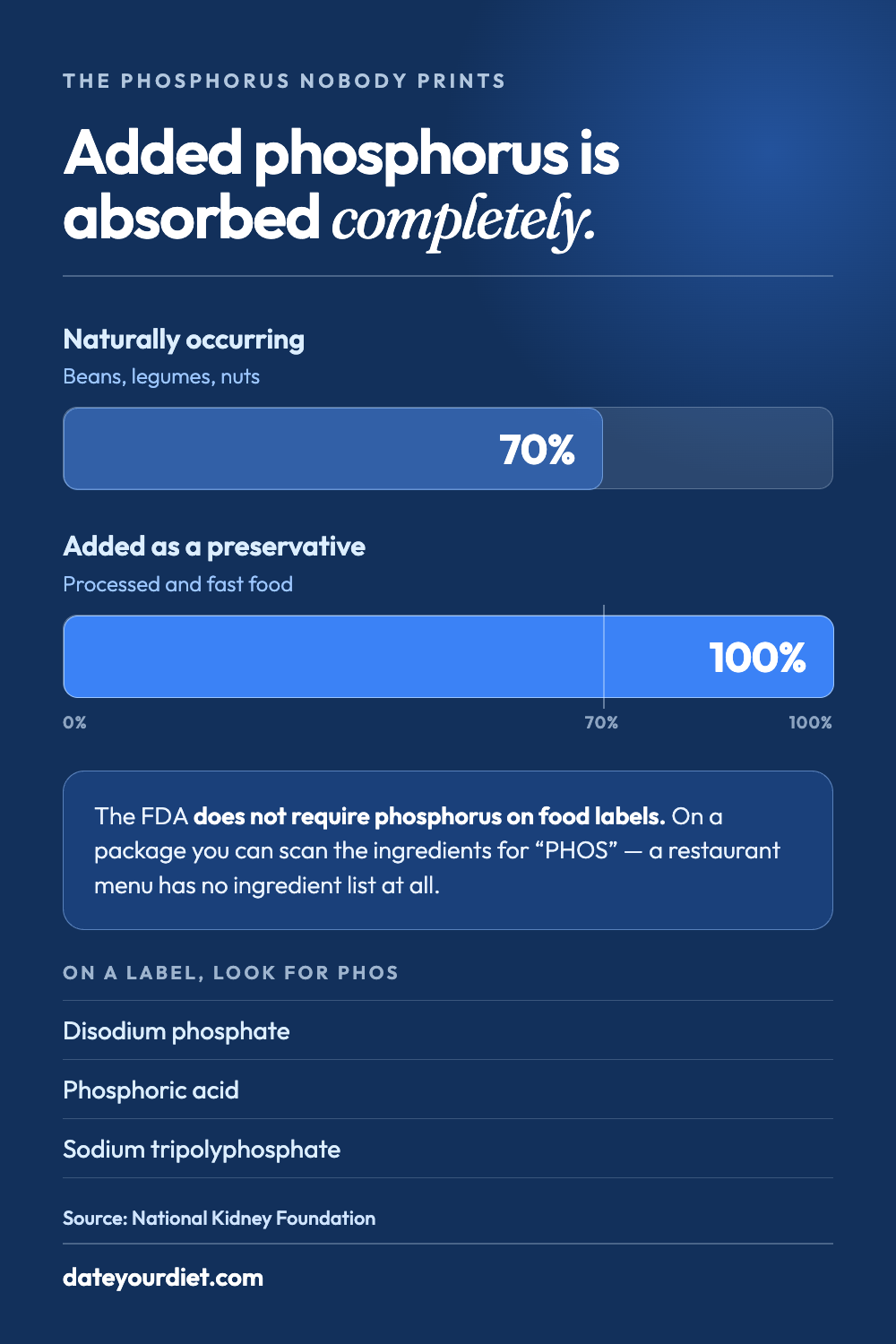
Added phosphorus is absorbed completely
The contrast in one graphic, with the additive names to look for on a label. Sourced from the National Kidney Foundation.
Open full size →4. “Just get water” — why fluid can be limited too
The reflex when someone can't drink alcohol, or is being careful, is to say “just get water.” For some people on dialysis, water is also measured.
NIDDK explains what fluid buildup does between hemodialysis sessions: “Excess fluid can build up in your body and may cause swelling and weight gain between dialysis sessions, changes in your blood pressure, your heart to work harder, which can lead to serious heart trouble, a buildup of fluid in your lungs, making it hard for you to breathe.” And the reason it can't simply be corrected at the next appointment: “Hemodialysis removes extra fluid from your body. However, hemodialysis can remove only so much fluid at a time safely. If you come to your hemodialysis with too much fluid in your body, your treatment may make you feel ill. You may get muscle cramps or have a sudden drop in blood pressure that causes you to feel dizzy or sick to your stomach.”
The counterintuitive part is what counts. NIDDK: “Foods that are liquid at room temperature, such as soup, contain water. Gelatin, pudding, ice cream, and other foods that include a lot of liquid in the recipe also count. Most fruits and vegetables contain water, such as melons, grapes, apples, oranges, tomatoes, lettuce, and celery. When you count up how much liquid you have in a day, be sure to count these foods.” NKF's dining-out guidance for people on dialysis lists the same trap in restaurant terms — alongside one glass of liquid, “remember to also count the following as part of your daily fluid intake: Soup, Ice-cream, Gelatin.”
As with everything else, the amount is personal: NIDDK says “Your health care provider can help you figure out how much liquid is right for you.”
What it changes at dinner. The starter and the dessert can be fluid, not just the drinks — so a soup course, a shared sorbet, and a topped-up water glass may all be spending from the same allowance. The considerate move is small and silent: don't push refills, don't order the table a round of anything, and if you're picking the set menu, notice that a soup-and-sorbet-heavy one leaves your date less room than a menu that doesn't.
5. What a menu can and can't tell either of you
Restaurant food is where the sodium is, and it's the one number a restaurant sometimes publishes. NKF's advice for people watching salt is to “Visit the restaurant's website which should list the sodium content of various dishes served there,” and if you're already seated, “you can request that the dish be served without salt.” The FDA gives the same two moves for eating out: “Ask for your meal to be prepared without table salt and request that sauces and salad dressings be served ‘on the side,’” and “ask if nutrition information is available and then choose options that are lower in sodium.”
Potassium and phosphorus are a different story. There is no equivalent lookup — the FDA doesn't require phosphorus on packaged labels at all, and no restaurant is publishing per-dish potassium. NKF's dining-out advice for people on dialysis works around the gap rather than through it, with things like choosing “a restaurant where you can ask for your food to be made without added salt and where they have freshly cooked options,” and portion strategies: “Ask for a to-go box when your food arrives and put half of your main dish in the box before you even start to eat. This may help control potassium, phosphorus, salt, and calories.”
What it changes at dinner. Pick a place with a real website and a kitchen that cooks to order, and pick it early enough that your date can look it up before you go. That one act — choosing a restaurant with published information a few days out instead of a spontaneous “let's see what's open” — removes almost all of the pressure without a single conversation about kidneys.
6. What not to do (etiquette, not medicine)
This section is manners, not sourced medical guidance. It reflects what respect looks like at a table.
Don't quiz them. Curiosity about their condition is not the same as caring about their evening. If they want to explain their labs, they will. Asking “so what are you allowed to have?” turns dinner into a medical interview and makes them the exhibit.
Don't order for them, and don't audit what they ordered. They have been managing this longer than you have known about it. Watching their plate, or saying “should you be eating that?”, is policing, and it is the single fastest way to make someone stop going out.
Don't announce their condition to the server. “She has kidney disease, so —” is their information to give, in their words, at the moment they choose. Let them make their own requests; a request for no added salt needs no explanation attached.
Don't make it the evening's topic. A person is not their diagnosis, and a date is not a support group. One practical question while choosing the restaurant, then move on to literally anything else.
Don't perform sacrifice. Ostentatiously ordering plain food “in solidarity” makes them responsible for your dinner too. Order what you want. Eat it happily.
Do offer the specific thing rather than the vague one. NKF's own guidance on supporting someone with kidney failure makes this point: instead of a vague “let me know how I can help,” offer concrete actions — its list includes “Bring over kidney-failure-friendly food” and, plainly, “Listen.” Applied to a date, the specific version is choosing the restaurant thoughtfully and letting them handle the rest.
And know that the stakes here are social, not just dietary. NKF notes that kidney failure “can make a person feel sick and often comes with anxiety, stress, and confusion,” and lists social withdrawal among the signs worth noticing. Eating out is one of the first things that gets dropped when it becomes exhausting. Making an evening easy is a real contribution to someone's life, not just good manners.
7. The version of this that fits in a text message
Four questions, all of which leave the answer where it belongs — with them:
- “Do you want to pick the place, or want me to send you two or three options first?” Gives them the veto without making them do the work if they'd rather not.
- “Anything about a menu that makes a place easy or annoying for you?” Open enough that they can say “I need to see sodium info,” “soup courses are a hassle,” or “nothing, I'm fine” — and all three are complete answers.
- “Is timing better on some days than others?” For someone on dialysis, days are not interchangeable, and this asks about it without asking about it.
- “Do you want me to say anything to the server, or would you rather handle it?” Almost always the answer is they'll handle it — and asking makes clear you weren't going to do it over their head.
Notice what none of them ask: what they can eat, what their numbers are, or how bad it is. You don't need any of that to plan a good evening. You need to pick somewhere flexible, ask once, and then be pleasant company — which was the assignment all along.
Would you go?
Say you would go on this date, and find people who would go with you.
Be the first to say you'd go on this date
Meet in public and tell a friend where you’re going.
Not medical advice — lifestyle information only.
Sources
Every claim above is quoted from a named authority's published page. Section 6 is etiquette rather than sourced guidance, and says so in the text.
- NIDDK (National Institutes of Health) — Eating Right for Chronic Kidney Disease
- NIDDK (National Institutes of Health) — Eating & Nutrition for Hemodialysis
- National Kidney Foundation — Phosphorus and Your Diet
- National Kidney Foundation — How to Be a Phosphorus Detective
- National Kidney Foundation — Dining Out With Confidence: On Dialysis
- National Kidney Foundation — Top 10 Tips for Reducing Salt in Your Diet
- National Kidney Foundation — 5 Ways to Help Your Friend or Family Member with Kidney Failure
- U.S. Food and Drug Administration — Sodium in Your Diet
Read next
Put it on your profile, not on the evening.
Say how you eat once — the constraints, the habits, the restaurants you'd say yes to — and see who already fits, instead of explaining it over dinner.
Create your free profileFree to create a profile, take the compatibility quiz, and chat with mutual matches.